

I used to live a life that moved in sync with my ultimate concierge. You know what I mean. Days that had a shape to them. Plans. People. Adventure. Hugs and kisses. “I love you” throughout the day. I had reasons to get dressed for something other than necessity. I did not think seriously about a time when one mate in a marriage would become ill. It was too painful. I am now living in reality. Part of my world has become small. Not cozy small. Not charming small. Small, like everything that is happening is within a few feet of me.

I did not envision this. One day, an unfortunate part of my life’s journey knocked on my door. Dementia. It has not been easy. It definitely has not been gentle. It’s hard watching the love of one’s life’s mind disappear, not all at once. That would be cleaner. This is slower. More precise. More painful. And I’m here, his loving wife, watching it happen with no weapon to stop it.

Loving Someone Through Dementia
I gaze into his eyes, wondering: “Where are you right now? What is it like inside your head? Is it confusing? Is it frightening? Are you aware that something is wrong? I am beside you to listen to you.” The wondering exhausts me. I note the occasional smile. I hear the occasional, “I love you,” “thank you,” “please,” and “Where’s Suzi?” I respond: “You are my heart. You are safe at home with America and me, and I love you to the moon and back.” This type of life is wearing. It muddles my mind. It exhausts my body. It controls my sleepless nights. It manifests itself in the way I face the day.
I push myself to show up where it is necessary. Family. Obligations. Mahjong with friends. An occasional lunch with a friend. Nothing makes me happy. I am very rational and tell myself that in every relationship, one partner will eventually become ill, and this is part of life’s journey. I play games with myself that, while my worldly life shrinks and is burdened with grief, I have allowed my inner world to expand. Who am I kidding?
The truth is, the major part of my lifestyle over the past three years has worn me out. This did not happen in a dramatic fall-apart way, but in a slow, steady, toxic way, the kind that builds quietly, where the emotional pain finally becomes unbearable as I share my ultimate concierge’s journey, wondering how unbearable it is for him, while knowing how unbearable it is for me. Since his journey into dementia began, he has never complained. I ask myself, “Is this because he is stoic, as men of his generation were? Is it because he refuses to burden me with more than he thinks I can handle?” Only he knows, and he cannot share.

My One-Star Hotel
Most days, I feel my brighter-than-life attitude has left the room. And it frightens me because unless I put all my resources together, I have no control over it. This is who I have become.
If my life were a hotel, it would be a one-star hotel. Not the charming kind you discover on some tucked-away street in Paris. I mean the kind where the lights flicker, and nothing works the way it should, and you keep thinking, “This cannot be where I am staying, can it?” My life with my ultimate concierge had range. It had texture. It had growth. It was five-star as long as he was by my side.
And now?
Here is the part I am wrestling with. When you check into a one-star hotel, it is temporary. You laugh about it. You make a story about it. You roll with it. You leave. But this? There is no checkout date. And then I ask myself another question. Can I appreciate positive things in life while living in this one-star hotel and still create moments that feel like five-star?
And I make myself answer, “Yes,” because I want to survive.
The Five-Star Moments I Still Hold On To
So, I take a walk outdoors with my pooch, America. I share Shabbat dinner and time with my daughter, son-in-law, and grandchildren. I live for the flicker of recognition in my ultimate concierge’s eyes. I give back to the ZOA with sincerity. And I have faith in God.
My Jewish faith holds me up, reminding me that I am not asked to understand everything. I am asked to keep showing up. Moses, who spoke to God more directly than any of us ever will, did not pretend to understand suffering. He asked God plainly, “Why have You done this?”
I find myself asking the same question. Why have You done this to my ultimate concierge?
We Become Our Own Night Operator
Like many of you who are facing an extremely distressing situation, I am living with you in a one-star hotel, with no one at the other end of the phone to fix what is broken. When a crisis arises, I have learned, from being widowed long ago, that we must become our own night operator. Why? Because no one can heal us but ourselves and time. We have to delve deep within, grieve openly, and, in time, learn to accept circumstances beyond our control.
When I lost my late husband to a sudden heart attack, there was no warning. A phone call told me Michael had died, and in that instant my life split in two. I threw the phone down and screamed, “No, no, no,” so loudly that the neighbor next door called the police, thinking I was being attacked. The shock was devastating. I was struck by lightning.
Now I am living through something entirely different. Not lightning, but a long fading sunset, in installments.
Michael’s sudden death demanded that I survive the shock. My ultimate concierge’s long illness is asking me to endure the slow unraveling of a life I cherished. And somewhere in both stories, I still stand.

What Survival Really Looks Like
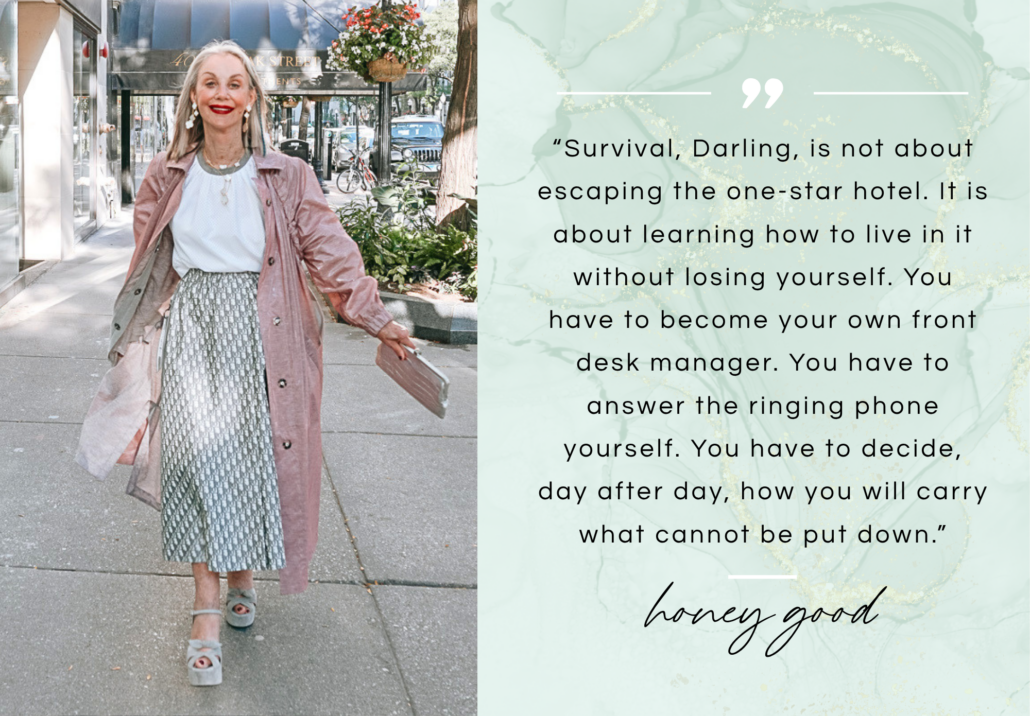
Survival, Darling, is not about escaping the one-star hotel. It is about learning how to live in it without losing yourself. You have to become your own front desk manager. You have to answer the ringing phone yourself. You have to decide, day after day, how you will carry what cannot be put down.
So this is what I say to myself: I will soften the edges of life where I can. I will live with quiet, kind hope. Not the kind that leaps too far ahead. Not the kind that demands guarantees. But the smaller sort of hope, the sort that asks only that I get through the day in front of me. Because there is no one at the front desk to check me out.
I tell myself this is where I am in my life. I am not expected to do it beautifully. I do not have to be strong every day. I will rest when I can. I will count my blessings that I can still hold my ultimate concierge’s hand, feel a squeeze back, and watch him smile, knowing that love is still happening, though in fragments.
I just have to keep going.
And that is harder than many people understand, because this type of survival is not glamorous. It is not dramatic. It is not the sort that earns applause. It is quiet endurance. It is waking up and doing it again. It is carrying grief in one hand and responsibility in the other.
Hope Is the Driver
And this is where the word hope comes into play. I often look up and ask, “Why did this happen?” Hope does not answer me in the voice I am used to hearing. It does not hand me a map. It does not tell me when this chapter will end. Instead, it hands me the next step in slow motion.
Stand up. You need motion. Darling, hope must be our driver. It is the stubborn engine inside us that keeps turning over even when the tank feels empty. Hope keeps us moving forward. Hope keeps our lights on. It does not erase sorrow, and it does not pretend life is easy. It simply whispers that there is still life to be lived inside the pain. Hope asks us to keep going, even if all we can manage is one small act of courage at a time.
Self Care Is Fuel
And in times of crisis, we must also remember that self care is not indulgence. It is fuel. We must rebuild a five-star discipline inside a one-star reality.
We must drink our water. Step out into the fresh air. Rest our bodies. Feed ourselves nourishing food. Be proactive about our health. Allow in the love of family and friends. Not because we feel like it all the time, but because without these acts of care, our engine will sputter. And when we are living under strain for far too long, it is often the smallest disciplines that save us. A nourishing meal. A short walk. A deep breath. A quiet prayer. A phone call with someone who understands. These simple acts are not small at all. They are the threads that keep us stitched together.
This is how we fill our tank. This is how we keep going. Not beautifully. Not perfectly. But deliberately.
A Deliberate Decision to Keep Going
And for where I am in my life, being deliberate is my hope. Not a promise about tomorrow, but a decision right now to keep going. To rise each morning and meet the day as it is. To care for myself and for the one I love. To accept the sorrow without letting it swallow every bit of light. To keep my heart open to grace, even in this one-star season. Amen. Amen.


+ show Comments
- Hide Comments
add a comment